
The First Stewards – 12,000 Years of Kumeyaay Heritage
Long before the first Spanish ship appeared on the horizon, long before any European map showed California’s coastline, long before written history recorded these lands—the Kumeyaay people were here. Not for years, not for centuries, but for twelve thousand years. To put that in perspective, when the ancient Egyptians were just beginning to farm along the Nile, the Kumeyaay had already been thriving in what we now call La Misión for over seven thousand years.
A Name That Describes the Land
The Kumeyaay (also known as Kumiai in Mexico, and sometimes called Diegueño by early anthropologists) called themselves “Those who face the water from a cliff”—with meyaay meaning “steep” or “cliff.” If you’ve ever stood on the coastal bluffs of La Misión looking out over the Pacific, you understand perfectly why they chose this name. It’s a description of both landscape and identity, connecting a people to their place in the most fundamental way possible.
The Kumeyaay territory was vast, stretching from present-day Oceanside, California in the north to south of Ensenada, Mexico, and extending east to the Colorado River. La Misión fell within the lands of the Tiipai, the southern branch of the Kumeyaay who inhabited the Laguna Mountains, Ensenada, and Tecate regions. This wasn’t a single tribe with centralized government, but rather a network of independent bands sharing language, culture, and kinship ties.
Not Just Surviving—Thriving
Here’s where we need to correct a common misconception. Early European accounts often portrayed indigenous peoples as simply “living off the land” in a kind of passive subsistence. Nothing could be further from the truth for the Kumeyaay. These were sophisticated environmental managers who actively shaped and improved the landscape over thousands of years.
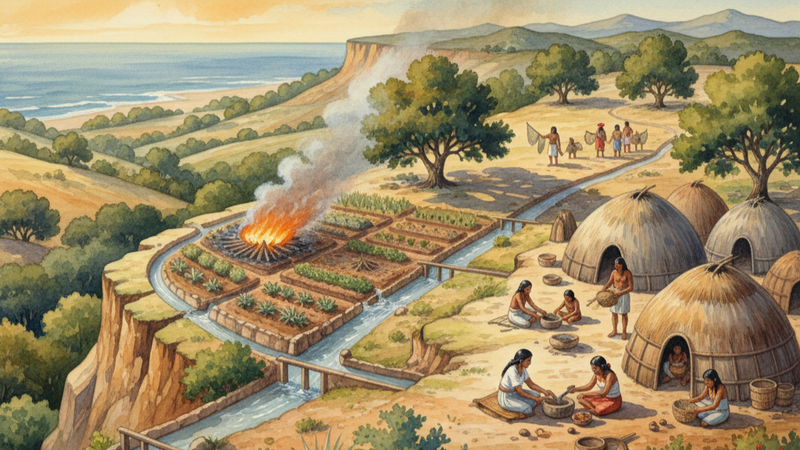
The Kumeyaay understood something that modern environmentalists are only now rediscovering: humans can be a positive force in ecosystems when they work with natural processes rather than against them. They adapted to changes in the environment and developed the ability to plant and grow crops, creating sophisticated water management systems that ensured enough moisture for growing grains even in semi-arid conditions.
When Spanish explorers first saw the lush meadows in valleys east of San Diego, they assumed they were gazing upon natural grasslands. They were actually looking at some of North America’s earliest and most skillfully managed grain fields. The Kumeyaay used controlled burning to prevent catastrophic wildfires, encourage new growth, and manage game populations. They created check dams and terraces to slow water runoff and prevent erosion. They selectively cultivated plants over generations, enhancing desirable traits.
A Calendar Written in Stone and Stars
One of the most impressive aspects of Kumeyaay culture was their astronomical knowledge. They built stone markers to track the movement of celestial bodies and constellations, knowing exactly when solstices and equinoxes approached. This wasn’t idle stargazing—it was practical science. These astronomical observations told them precisely when to plant and harvest crops, when to move to seasonal camps, when to prepare for weather changes.
Archaeological sites throughout the region reveal these ancient observatories—carefully placed stones that align with the rising or setting sun on specific dates, creating a calendar as reliable as any written almanac. The Kumeyaay didn’t need paper to record the seasons; they wrote their calendar in stone and read it in the stars.
The Annual Cycle: Moving with the Seasons
The Kumeyaay weren’t sedentary village dwellers in the European sense. Instead, they practiced what anthropologists call “seasonal transhumance”—moving between different elevations and locations throughout the year to harvest different resources at their peak availability. This wasn’t aimless wandering; it was a carefully planned annual cycle refined over thousands of years.
They maintained two main village sites: a summer and fall village at higher elevations where they could escape coastal heat and harvest acorns, pine nuts, and hunt deer; and a winter camp at lower elevations near the coast where they could fish, gather shellfish, and take advantage of milder temperatures.
This seasonal movement served multiple purposes. It allowed them to harvest a wider variety of foods throughout the year. It prevented overexploitation of any single area by giving each location time to regenerate. And it distributed their impact across the landscape rather than concentrating it in one place.
What They Ate: Masters of Biodiversity
The Kumeyaay diet was remarkably diverse and nutritionally balanced. Acorns were a staple—Kumeyaay women gathered them for weeks each fall, processing them with grinding stones (you can still see the bedrock mortars they created throughout the La Misión area) to make shawii, an acorn paste that could be stored and prepared in various ways.
But acorns were just the beginning. They gathered chia seeds, wild onions, yucca, agave, cactus fruits, various berries, pine nuts, and dozens of other plant foods. Along the coast and estuary at La Misión, they harvested shellfish—clams, mussels, abalone—leaving behind shell middens (ancient trash heaps) that archaeologists study today. They caught fish with sophisticated traps, spears, and hook-and-line techniques.
Men hunted deer, antelope, rabbits, and other game with bows and arrows. They knew animal behavior intimately—where they watered, what they ate, how they moved with the seasons. Nothing was wasted. Hides became clothing and shelter material. Bones became tools and ornaments. Sinew became cordage.
This wasn’t just successful hunting and gathering—it was complete mastery of a complex ecosystem. The Kumeyaay knew which plants had medicinal properties, which were edible only at certain times of year, which parts of animals were most nutritious, and how to process foods to make them safe and preserve them for later use.
Village Life and Social Organization
Kumeyaay villages consisted of dome-shaped shelters called ‘ewaa, built from poles covered with grass, brush, or bark, with one door and a smoke hole in the roof. These structures were perfectly adapted to the climate—cool in summer, warm in winter, easy to build and repair, and requiring only renewable materials readily available in the environment.
The Kumeyaay were organized into groups called Sh’mulqs, each with its own territory and leader called the Kwaipai. The Kwaipai was assisted by the Kuseyai—a council of medicine men in charge of religion, medicine, and other important duties. Together they made decisions for the community, resolved disputes, and maintained cultural traditions.
This wasn’t a rigid hierarchy. Leadership was earned through wisdom, skill, and service to the community rather than inherited. Women, particularly older women, held significant influence as knowledge keepers and advisors. Decisions affecting the whole community were made collectively after discussion and consensus-building.
Art, Music, and Cultural Continuity
The Kumeyaay created beautiful and functional objects—finely woven baskets so tight they could hold water, pottery decorated with geometric designs, shell beads used as currency and ornament, and carved stone and bone tools that were as aesthetically pleasing as they were practical.
Music played a central role in Kumeyaay culture. Bird Songs—considered the oldest form of music in California—are a series of songs that tell people how they should live their lives and give instructions on how to conduct ceremonies. These songs have been passed down orally through countless generations and are still performed today by Kumeyaay descendants. Think about that: music that was being sung when the pyramids of Egypt were being built is still being sung today.
The Archaeological Evidence at La Misión
The La Misión area is particularly rich in Kumeyaay archaeological sites. Near Playa La Misión, archaeologists have uncovered stone tools, bedrock mortars for grinding acorns, pottery fragments, and the remains of the “Mujer de Humo” (Woman of Smoke), believed to have lived over 800 years ago. These discoveries aren’t just academic curiosities—they’re tangible connections to real people who lived, loved, raised families, and built communities right here.
When you walk the beach or hike the hills around La Misión, you’re literally walking in the footsteps of thousands of years of human history. That smooth depression in a boulder might be where a Kumeyaay woman ground acorns five centuries ago. That dark soil in a hillside might be from a cooking fire that burned a thousand years ago. Those shell fragments weathering out of a coastal bluff might be the remains of a meal eaten when Europe was still in the Dark Ages.
The Impact of Contact
We need to be honest about what happened when Europeans arrived. The mission system fundamentally disrupted Kumeyaay culture. Disease—smallpox, measles, influenza—swept through indigenous populations who had no immunity to these Old World diseases. The mission system required conversion to Christianity, agricultural labor, and living in permanent settlements rather than following traditional seasonal migration patterns.
Population declined dramatically. Some estimates suggest that indigenous populations in California decreased by 90% or more in the century following Spanish contact. This wasn’t a gentle cultural exchange—it was a catastrophe.
Traditional practices were suppressed. Sacred sites were destroyed or converted to Christian purposes. The seasonal migration patterns that had sustained the Kumeyaay for millennia were disrupted. Children were separated from elders who transmitted cultural knowledge. Languages began to fade as Spanish became dominant.
This is a difficult history, but it’s important to acknowledge honestly. The La Misión we enjoy today was built partly through the displacement of people who had called it home for twelve thousand years.
A Living Culture
But here’s the crucial point: the Kumeyaay didn’t disappear. They adapted, survived, and maintained their cultural identity despite everything thrown at them. Today, Kumeyaay descendants continue to live in communities throughout northern Baja California and southern California.
They maintain traditional crafts like basket weaving and pottery. They perform Bird Songs and conduct traditional ceremonies. They teach their languages to new generations. Some Kumeyaay families have even entered Baja California’s thriving wine industry, bringing traditional knowledge of the land to a new endeavor.
The Kumeyaay Museum in Campo, California, and various cultural centers in Baja California work to preserve and share Kumeyaay history and culture. Archaeological sites are being protected. Traditional place names are being restored. The story is being told more fully and accurately.
Why This History Matters Today
Understanding the Kumeyaay heritage of La Misión isn’t just about appreciating the past—it changes how we see and interact with the present landscape.
When we understand that these hills and valleys were actively managed for thousands of years, we realize that the “natural” landscape we enjoy was partly shaped by human hands. The biodiversity we treasure was enhanced by Kumeyaay practices. The resilience of ecosystems we depend on was built by people who understood that taking care of the land means the land will take care of you.
This perspective challenges the modern assumption that nature is pristine only when humans are absent. The Kumeyaay prove that humans can be positive participants in ecosystems when we operate with deep knowledge, long-term thinking, and respect for natural processes.
It also reminds us that we’re newcomers here. The oldest non-indigenous family in La Misión has been here about 160 years. The LMPOA community has existed for a few decades. The Kumeyaay were here for twelve thousand years. That kind of perspective is humbling.
Moving Forward with Respect
As we enjoy La Misión today—surfing the waves, hiking the trails, watching birds in the estuary—we’re benefiting from a landscape that was carefully tended for millennia. The least we can do is acknowledge that history, protect the archaeological sites that remain, and approach this land with some of the respect and understanding that allowed the Kumeyaay to thrive here for so long.
When you see a bedrock mortar on a hike, resist the urge to touch or photograph yourself with it—these are sacred sites and should be treated with reverence. If you encounter artifacts, leave them in place and report the location to authorities so archaeologists can properly study and protect the site. Support efforts to preserve Kumeyaay culture and language.
And perhaps most importantly, remember that La Misión’s human story didn’t begin with European contact. For twelve thousand years before that first Spanish ship appeared, this was home to people who knew every canyon, every plant, every animal, every season with an intimacy we can only imagine. They left their mark on this land not through roads and buildings, but through knowledge passed down through generations, through careful management that enhanced rather than degraded, and through a cultural continuity that survived despite tremendous challenges.
That’s the real foundation of La Misión’s human history—and it deserves our recognition and respect.
