
Member Login

Welcome back to LMPOA

The Spanish Colonial Period (1787-1834)

Mission Bells and Adobe Dreams – The Spanish Colonial Period (1787-1834)

On March 28, 1787, a Spanish Dominican missionary named Father Luis Sales stood on land that had been Kumeyaay territory for twelve thousand years and did something that would change this place forever: he founded Misión San Miguel Arcángel de la Frontera. Those last words—”de la Frontera,” meaning “of the frontier”—would prove prophetic. This mission marked not just a religious boundary, but the edge of two colonial empires, and eventually, it would influence where the line between Mexico and the United States would be drawn.

Why Here?

Father Sales didn’t choose this location randomly. Early Spanish reports described exactly what had attracted the Kumeyaay for millennia: welcoming native villages, abundant pasture land, fresh water from the Río Guadalupe, wildlife everywhere, a lush estuary, and fertile valley soil. The strategic location along the coastal route between established missions in Alta California and those further south in Baja California was the final deciding factor.

The mission’s official name honored Saint Michael the Archangel, patron of soldiers and protector of the faithful—appropriate for a frontier outpost. But it was that frontier designation that made it unique. This wasn’t just another mission in the chain—it was the boundary marker between Dominican territories in Baja California (administered from Mexico City) and Franciscan territories in Alta California (administered from Spain).

In 1773, fourteen years before the mission’s founding, a large cross had been erected nearby to formally mark this territorial boundary. That cross and the mission that followed would later play a role in determining where the international border between Mexico and the United States would eventually be drawn. Geography and politics were intertwining in ways no one could have predicted.

The First Years: Hope and Rapid Growth

The mission’s early days must have seemed promising to Father Sales. Within the first six months, 123 indigenous people had been baptized. By the end of 1787, there were 137 neophytes (as the Spanish called indigenous converts) living at the mission. The community grew steadily, reaching somewhere between 350-400 residents in the 1820s, including both Spanish inhabitants and Kumeyaay tribal members who had accepted mission life.

But we need to pause here and acknowledge what this “conversion” really meant. For the Kumeyaay, accepting mission life wasn’t simply a matter of adopting new religious beliefs. It meant fundamentally changing everything about how they lived.

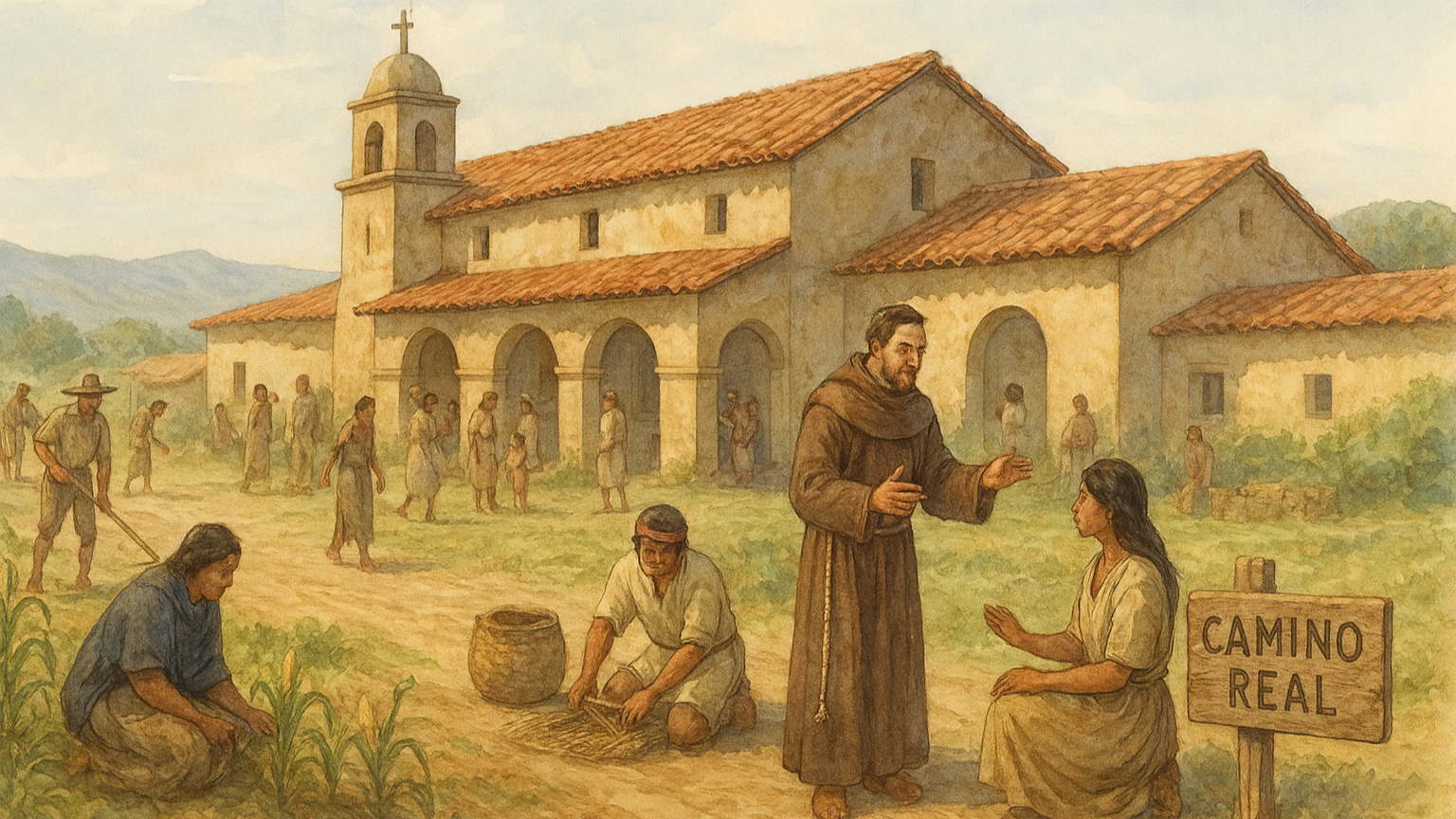
The mission system required living in one permanent location year-round rather than following the seasonal migration patterns that had sustained Kumeyaay culture for thousands of years. It meant agricultural labor on Spanish terms—tending crops and livestock according to European methods rather than traditional Kumeyaay land management. It meant learning Spanish, adopting European-style clothing, living in adobe buildings rather than traditional ‘ewaa structures, and following the rigid daily schedule of mission bells.

Children were often separated from families for religious instruction. Traditional ceremonies were prohibited as “pagan” practices. The whole system of knowledge about plants, animals, seasons, and land management that had been passed down for generations was suddenly deemed irrelevant or even heretical.

Some Kumeyaay embraced mission life—perhaps seeing opportunities in the new system, genuine spiritual conversion, or simple survival strategy. Others resisted, fleeing to the backcountry where Spanish authority couldn’t reach. Many lived in a difficult in-between space, trying to balance old ways with new requirements. This wasn’t a simple story of willing conversion—it was a complex, often painful negotiation of cultural survival under colonial pressure.

Building a New Community

Despite these challenges (or perhaps because the Spanish didn’t fully understand them), the mission grew. Adobe buildings rose from the valley floor—a church, living quarters for neophytes, workshops, storehouses, and the father’s residence. Fields were cleared and planted with European crops: wheat, barley, corn. Livestock brought from other missions grazed on what had been wild grasslands (or, more accurately, Kumeyaay-managed grasslands, though the Spanish didn’t recognize the distinction).

The mission introduced new technologies and crops that would permanently change the region: grape cultivation for sacramental wine (a precursor to today’s Valle de Guadalupe wine industry), olive trees, citrus, European vegetables, cattle, horses, sheep, and pigs. The mission workshop taught indigenous people European crafts like blacksmithing, carpentry, masonry, and leatherworking.

This created a hybrid economy and culture that was neither fully Spanish nor fully Kumeyaay, but something new emerging from the collision of both. The mission used Kumeyaay labor with European tools to create agricultural products for both local consumption and trade with other missions along the Camino Real—the Royal Road that connected all of California’s missions from San Diego to those further south.

The Camino Real: Highway of History

The mission’s location on the Camino Real made it strategically important. Travelers, missionaries, soldiers, traders, and eventually Mexican officials all stopped here on their journeys. It was a place of exchange—goods, information, news, gossip—connecting this frontier outpost to the wider colonial world.

The Camino Real followed roughly the same coastal route that Highway 1 does today. If you’ve driven this road, you’ve traced the path of Spanish missionaries on horseback, soldiers in leather armor, carts laden with trade goods, and messengers carrying news that might be weeks or months old by the time it arrived.

Mission bells would ring to announce arriving travelers. The mission provided hospitality—food, shelter, fresh horses—as part of its role in the colonial system. In return, travelers brought news from other missions, letters from church authorities, trade goods, and connections to the larger colonial enterprise.

When Nature Struck: The Floods of 1810

In 1810, twenty-three years after its founding, disaster struck. Devastating floods swept down the Río Guadalupe, destroying much of the mission’s farmland. The river that had made this location so attractive—providing water, irrigation, fish, and rich bottomland—turned against the mission with violent force.

This wasn’t unusual for Baja California. The region’s climate pattern means long dry periods punctuated by occasional intense storms. The Kumeyaay had adapted to this pattern through seasonal migration and diversified resource use. The Spanish mission system, tied to permanent settlements and European-style agriculture, was more vulnerable.

The flood damage was severe enough that the community had to temporarily relocate north to a site called El Descanso, which became known as “San Miguel la Nueva” (New San Miguel), while the original location was called “San Miguel la Vieja” (Old San Miguel). Eventually, they returned and rebuilt, but the flood was a reminder that even with European technology and Christian faith, humans weren’t fully in control of nature.

After Mexican Independence: The Beginning of the End

Everything changed in 1821 when Mexico gained independence from Spain. The new Mexican government had different priorities and pressures than colonial Spain. One major issue was the enormous power and landholdings of the Catholic Church.

Starting in the 1820s and accelerating in the 1830s, Mexico implemented secularization policies designed to reduce church power and redistribute mission lands. In theory, mission lands were supposed to be given to the indigenous people who had worked them. In practice, they often ended up in the hands of politically connected ranchers and landowners.

For Misión San Miguel, secularization meant the end of its original purpose. In 1830, there was an attempt to revive the mission with new adobe buildings—perhaps a last desperate effort to maintain the system. But by 1834, the mission was finally abandoned due to lack of missionaries willing to serve there.

The neophytes who had lived at the mission for decades suddenly found themselves without the structure (however oppressive it may have been) that had organized their lives. Some returned to traditional Kumeyaay communities in the backcountry. Some stayed in the area, adapting to the new rancho system that was emerging. Some moved to other missions that were still functioning. It was a period of tremendous upheaval and uncertainty.

The Legacy: What Remains

Today, you can still visit the ruins of the original mission in Ejido La Misión, located behind the local school and north of Highway 1. The weathered adobe walls stand as tangible connections to this period—you can see the thickness of the walls, the outline of rooms, the remnants of arched doorways.

These ruins are protected historical sites, and they deserve our respect. They represent a complex period that was simultaneously a time of cultural collision, religious transformation, economic change, and human adaptation. Different people see different things in these ruins.

For some, they represent the spread of Christianity and European civilization to a remote frontier. For others, they’re monuments to cultural suppression and colonial exploitation. For many, they’re both—complicated reminders that history is rarely simple, that people in the past made choices with mixed motives and uncertain outcomes, just as we do today.

The Mission Period’s Lasting Impacts

The Spanish mission period was relatively brief—just 47 years from founding to abandonment. But its impacts shaped La Misión permanently in several ways:

Agricultural Changes: European crops, livestock, and farming methods permanently altered the landscape. The wild and managed grasslands that had existed for thousands of years were transformed. The mission introduced irrigation techniques, fruit tree cultivation, and viticulture that would eventually lead to today’s wine industry.

Population Changes: The concentration of indigenous people at the mission, combined with disease, fundamentally altered Kumeyaay demographics. Traditional settlement patterns and seasonal migration were disrupted in ways that couldn’t simply be resumed after the mission closed.

Built Environment: Adobe architecture, introduced by the Spanish, influenced building styles in the region for generations. The mission compound’s layout—buildings organized around a courtyard or plaza—set a pattern that continues in Mexican architecture today.

Religious and Cultural Synthesis: Catholicism, introduced through the mission, merged with indigenous beliefs to create hybrid practices and traditions that persist. Many families in La Misión today are Catholic because of the mission period, but their Catholicism often includes elements that would be unfamiliar to Spanish priests.

Land Tenure Changes: The mission period began the process of transforming land from communally used Kumeyaay territory to Spanish colonial holdings to Mexican ejidos to private property—a progression we’ll explore in later articles.

A Complex Heritage

The mission period is probably the most controversial chapter in La Misión’s history, and reasonable people can view it differently. It brought together two completely different worldviews—indigenous and European, pre-literate and written, seasonal and sedentary, polytheistic and monotheistic—in a colonial context where power was fundamentally unequal.

The missions were instruments of empire, designed to transform indigenous people into Spanish subjects. They used coercion, however gently rationalized by missionary zeal. They disrupted cultures and families. They introduced devastating diseases. The population decline among California’s indigenous peoples during the mission period was catastrophic.

Yet they also represent real human stories of adaptation, survival, and the creation of new hybrid cultures. Many people today trace their ancestry to both Spanish missionaries and Kumeyaay neophytes. The mission period is part of their family story, complicated and difficult as that may be.

Walking Among the Ruins

When you visit the mission ruins today, take a moment to think about the layers of human experience those adobe walls witnessed. Spanish priests conducting mass in Latin. Kumeyaay people learning European crafts while remembering their grandparents’ stories. Children born in the mission who knew no other life. The daily sound of mission bells organizing time in a way completely foreign to traditional Kumeyaay rhythms. The smell of wheat bread baking, cattle in corrals, incense in the chapel.

Think about the floods that destroyed fields, the earthquakes that cracked walls, the slow decay after abandonment. Think about later generations using mission stones for their own buildings, gradually reducing the complex to ruins. Think about modern archaeologists carefully excavating and documenting, trying to understand what happened here.

Those weathered walls connect us to a pivotal moment when two worlds met, collided, and were forever changed. It wasn’t always pretty, it wasn’t always just, but it was profoundly human—people doing what people do, trying to make sense of their world, seeking meaning and security, adapting to forces beyond their control.

The mission bells may have stopped ringing in 1834, but their echoes still resonate through La Misión’s landscape and culture. Understanding this period—with all its complexity, controversy, and consequence—helps us understand the community we’re part of today.