
Rancho Days – Family Roots and Cattle Country (1862-1938)
After the mission bells fell silent in 1834, La Misión entered a quieter but equally important chapter in its history. The drama of cultural collision gave way to a different story—one of families establishing roots that would stretch across generations, of cattle ranching on land that had once been communal mission holdings, and the gradual transformation of this frontier region into something recognizably modern.
The Gap Years: 1834-1862
The period between the mission’s abandonment and the establishment of the first major rancho was a time of uncertainty and transition. Former mission lands fell into a kind of legal limbo. Some former neophytes stayed in the area, working the land informally. Others left for the backcountry or joined relatives in communities that had resisted mission life. A few entrepreneurial individuals claimed parcels and tried their hand at farming or ranching.
Mexico was dealing with larger issues during this period—internal political conflicts, economic challenges, and the looming threat from its northern neighbor. In 1846-1848, the Mexican-American War redrew the map of North America. The Treaty of Guadalupe Hidalgo ceded Alta California and much of the American Southwest to the United States, but Baja California remained Mexican territory.
The border was now just miles north of La Misión. That old mission designation “de la Frontera”—of the frontier—took on new meaning. La Misión truly was at the frontier now, close enough to the new United States border to feel its influence but firmly on the Mexican side of the line.
Enter the Crosthwaites: 1862
In 1862, a man with the wonderfully multicultural name of Felipe Crosthwaite Armstrong made a decision that would shape La Misión for generations to come. Felipe was a Mexican citizen of Irish descent—his name alone tells you something about the blending of cultures that characterized 19th-century Baja California.
Crosthwaite purchased 7,500 hectares (about 18,500 acres) from the Federal Government, lands that had been part of the old mission holdings. He called his property Rancho La Misión Vieja de San Miguel—acknowledging the area’s mission past while establishing something new for the future.
Think about what 7,500 hectares means. That’s roughly 29 square miles of land stretching from the coast inland, encompassing what we now know as Playa La Misión, the valley where the Río Guadalupe flows, and the hills rising to the east. This wasn’t a small homestead—this was empire-building on a personal scale, the kind of vast land grant that characterized frontier regions where land was plentiful but settlers were scarce.
The Rancho Economy
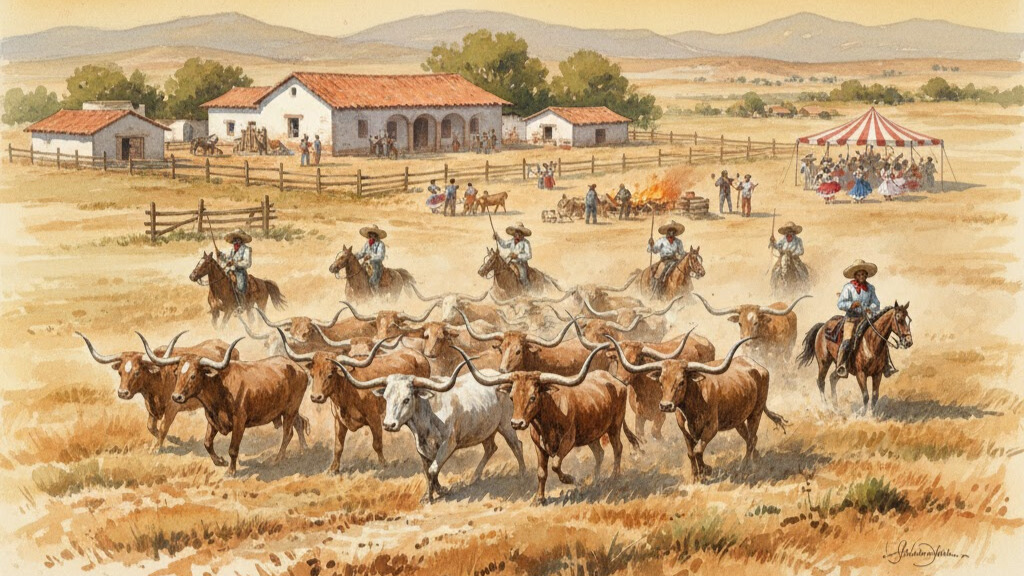
Rancho La Misión Vieja operated primarily as cattle country. The same grasslands that had supported Kumeyaay game for millennia, then mission livestock for decades, now sustained herds of cattle bearing the Crosthwaite brand.
This was the era of the vaquero—the Mexican cowboy whose skills and style would later influence the American cowboy culture. Vaqueros on horseback managed the cattle herds, skills passed down from Spanish traditions but adapted to the rugged Baja California terrain. The word “buckaroo” that American cowboys used? It’s an anglicized version of “vaquero.”
The vaquero culture would eventually contribute something unique to La Misión—the Baile Calabaceado, that distinctive folk dance that originated from cowboy gatherings and is still performed today. When you watch that dance at Fiesta en La Misión, you’re seeing a living connection to the rancho period.
Rancho life followed seasonal rhythms different from both Kumeyaay patterns and mission schedules. Spring meant calving season and the beginning of the grazing cycle. Summer brought cattle drives to market. Fall was the time for roundups and branding. Winter allowed for equipment repair and preparation for the next cycle.
The rancho produced more than just beef. Hides and tallow (rendered fat used for candles and soap) were valuable trade goods. Horses were raised both for ranch work and for sale. The fertile valley along the Río Guadalupe supported crops—wheat, corn, beans—primarily for rancho consumption but also for local trade.
Daily Life on the Rancho
Life on Rancho La Misión Vieja was hard work but relatively self-sufficient. The rancho was a small world unto itself, producing most of what it needed and trading for the rest.
The main ranch house—likely a substantial adobe structure—would have been surrounded by corrals, barns, storage buildings, a blacksmith shop, and housing for vaqueros and their families. During peak seasons like roundups, the rancho could employ dozens of workers. During quiet seasons, a smaller core crew maintained operations.
Women on the rancho managed households, gardens, preserved food, made clothing, and often kept the rancho accounts. Their work was every bit as essential as the vaqueros’ but is less well documented in historical records—a common pattern in frontier history.
Children grew up with responsibilities. By age seven or eight, they were expected to help with chores appropriate to their abilities. This wasn’t child labor in the exploitative sense—it was socialization into the skills they’d need as adults. A boy might start by feeding chickens and graduate to helping with horse breaking. A girl might begin by gathering eggs and learn to manage a kitchen garden and preserve food for winter.
The Crosthwaite Legacy
What’s remarkable about the Crosthwaite family isn’t just that they established a major rancho—it’s that their connection to La Misión continues today, over 160 years later. Crosthwaite descendants still live in the area, representing one of the longest continuous family presences in the region’s documented history.
This kind of multi-generational rootedness is increasingly rare. In modern America, families move frequently for jobs, education, or lifestyle. But the Crosthwaites stayed, through Mexican political upheavals, through the Mexican Revolution, through Prohibition (when Baja became a destination for Americans seeking legal alcohol), through the rise of tourism, and into the modern era.
Their continued presence represents something important about La Misión—it’s a place that keeps drawing people back, generation after generation. There’s something about this particular piece of coast, valley, and hills that makes people want to stay, to invest in place rather than chasing opportunities elsewhere.
Land, Power, and Inequality
We need to acknowledge the less romantic aspects of the rancho system. The establishment of large private ranchos represented a concentration of land ownership that excluded most people from property ownership. While the mission system had been problematic in its own ways, at least theoretically the land was held for religious purposes and indigenous benefit (however poorly that worked in practice).
The rancho system was explicitly about private wealth accumulation. Workers on the rancho—vaqueros, agricultural laborers, domestic workers—owned nothing. They worked for wages or shares, living at the mercy of rancho owners who controlled employment, housing, and often access to credit through the tienda de raya (company store).
This created a stratified society with clear divisions between landowners and laborers, a pattern that would persist in rural Mexico for generations. Some historians argue this inequality contributed to the tensions that exploded in the Mexican Revolution of 1910-1920.
During the rancho period at La Misión, most residents weren’t Crosthwaites—they were the workers and their families who made rancho operations possible but owned little themselves. Their stories are harder to recover because they left fewer written records, but they were equally part of La Misión’s history.
The Impact of the Mexican Revolution
The Mexican Revolution (1910-1920) was a watershed moment in Mexican history, though its effects played out over decades. The revolution began as a protest against the long dictatorship of Porfirio Díaz and evolved into a complex conflict involving multiple factions with different visions for Mexico’s future.
One major revolutionary demand was land reform—”Tierra y Libertad” (Land and Liberty) was a revolutionary slogan. Peasants and workers demanded redistribution of land concentrated in huge estates. The revolutionary constitution of 1917 included provisions for land reform through the ejido system, which we’ll discuss in the next article.
Baja California was relatively peripheral to the revolution’s main conflicts, which raged in central and northern mainland Mexico. But the revolution’s aftermath would fundamentally change land tenure patterns throughout Mexico, including at La Misión.
The Rancho Period’s Contributions
Despite its inequalities, the rancho period contributed important elements to La Misión’s character:
Vaquero Culture: The horsemanship skills, music, dance, and traditions of vaquero culture enriched the region’s cultural life. The Baile Calabaceado and other folk traditions that we celebrate today emerged from this period.
Agricultural Development: The rancho period saw continued improvement of irrigation systems, experimentation with crops suited to the climate, and development of local knowledge about what worked agriculturally in La Misión’s specific conditions.
Infrastructure: Trails were improved, wells were dug, buildings were constructed. The rancho period left a physical legacy that subsequent generations built upon.
Family Continuity: The Crosthwaite family and other families who settled during this period created continuity and institutional memory. Long-term residents who remember their grandparents’ stories about the rancho days help connect us to this history.
Economic Networks: The rancho participated in regional and international trade networks, connecting La Misión to Ensenada, Tijuana, San Diego, and beyond. This began the process of economic integration that continues today.
Transitions: From Rancho to Ejido
By the 1930s, the rancho system’s days were numbered. The Mexican government, implementing revolutionary land reform promises, was establishing ejidos throughout the country. The vast landholdings of the Porfiriato era were being broken up and redistributed.
In 1937-1938, this process reached La Misión. The federal government allowed a group of people to establish Ejido La Misión under the Agrarian Law. This didn’t happen overnight—it involved legal processes, surveys, negotiations, and the physical work of establishing new settlements.
For the Crosthwaite family, this meant losing control of much of their land. For landless workers and peasants, it meant the opportunity to own and work land communally. For La Misión as a place, it meant another fundamental transformation in how land was held, used, and understood.
The rancho period was ending, not with drama like the mission period’s closure, but through bureaucratic and legal processes that reflected Mexico’s ongoing effort to address the inequalities that had contributed to revolution.
Remembering the Rancho Era
Today, the rancho period lives on in several ways. The Crosthwaite family’s continued presence is the most obvious connection. The vaquero cultural traditions performed at Fiesta en La Misión keep those skills and aesthetics alive. Some of the physical infrastructure—wells, walls, corrals—dates to this period, though much has been rebuilt or replaced.
More subtly, the rancho period established patterns of land use and settlement that influence La Misión today. The locations of communities, the routes of roads, the placement of wells and irrigation systems—many of these practical arrangements trace back to decisions made during the rancho era.
The rancho period also reminds us that La Misión’s history isn’t just about dramatic moments of transformation. Sometimes history is about continuity, about families staying put across generations, about the patient work of building something meant to last.
When you drive through La Misión today and see older residents who’ve spent their entire lives here, who remember their grandparents’ stories, who have a deep knowledge of the land earned through generations of experience—you’re seeing the legacy of the rancho period. That kind of rootedness, that multi-generational investment in place, is increasingly precious in our mobile modern world.
The rancho period was the bridge between mission colonialism and modern community—a time when La Misión was finding its identity as neither indigenous homeland nor Spanish mission, but something distinctly Mexican, built on layers of history but looking toward its own future.
